01 / Make a sample record
Give each piece a simple identifier. Record its dimensions, visible structure and anything you know about its source or treatment. If a property is unknown, write that down rather than filling the gap with an assumption. Similar-looking samples can behave very differently.
Place the samples in the same light. Look at the broad surface, the edge and any directional pattern. Turn each piece slowly and note what changes. This first record gives later tactile observations something concrete to refer to.
02 / Ask one physical question
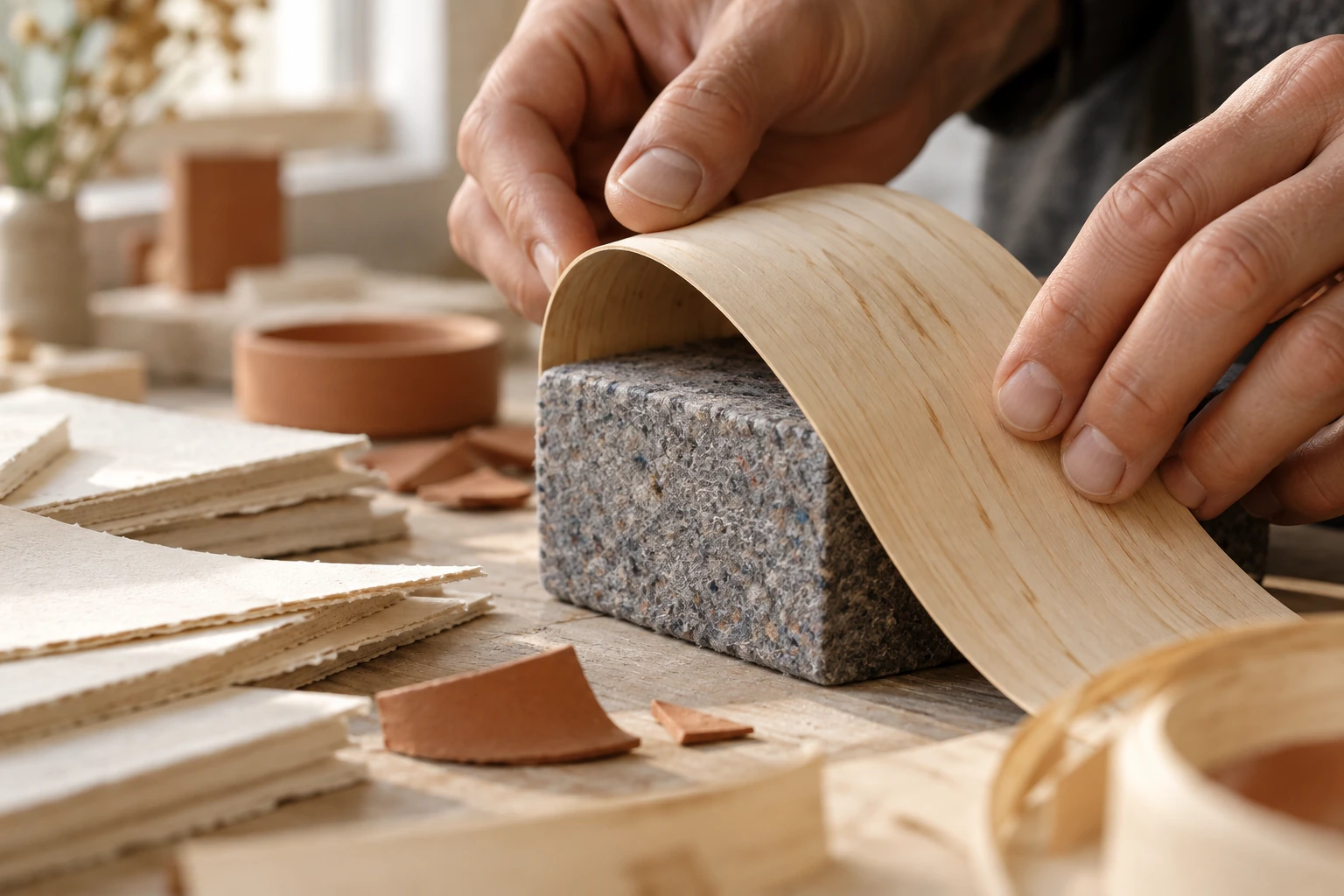
Choose a low-risk gesture appropriate to your samples: a gentle bend, a light press, a fold or a removable connection. Keep dimensions and support as consistent as possible. Do not cut, heat or aggressively stress unknown materials; use the manufacturer's handling guidance for any real process.
Describe the response in ordinary language. Does the piece spring back, hold a crease, shed fibres or change colour where it bends? Note the direction and the conditions. A single result applies to that sample and that test; it does not establish a universal material property.
03 / Connect the observation to a purpose
Only after the comparison should you ask which response suits your design question. A soft sample might feel welcoming but fail to hold the intended form. A stiff sample may offer structure but need a different joint. Keep the trade-off visible instead of assigning a simple good or bad label.
Make a tiny prototype that tests the relevant relationship. Try a reversible joint where possible so that you can separate the parts and inspect them. Photograph the prototype from a consistent viewpoint and record one next test. The goal is to reduce a specific uncertainty, not to collect attractive objects.
Save the sample identifier, conditions, observed behaviour and the next question together. A beautiful photograph without this context is a weak research record.
Your working checklist
- Match sample dimensions when making a comparison.
- Keep observations separate from design conclusions.
- Leave unknown sourcing and treatment information explicit.
- Inspect how the prototype can be repaired or taken apart.